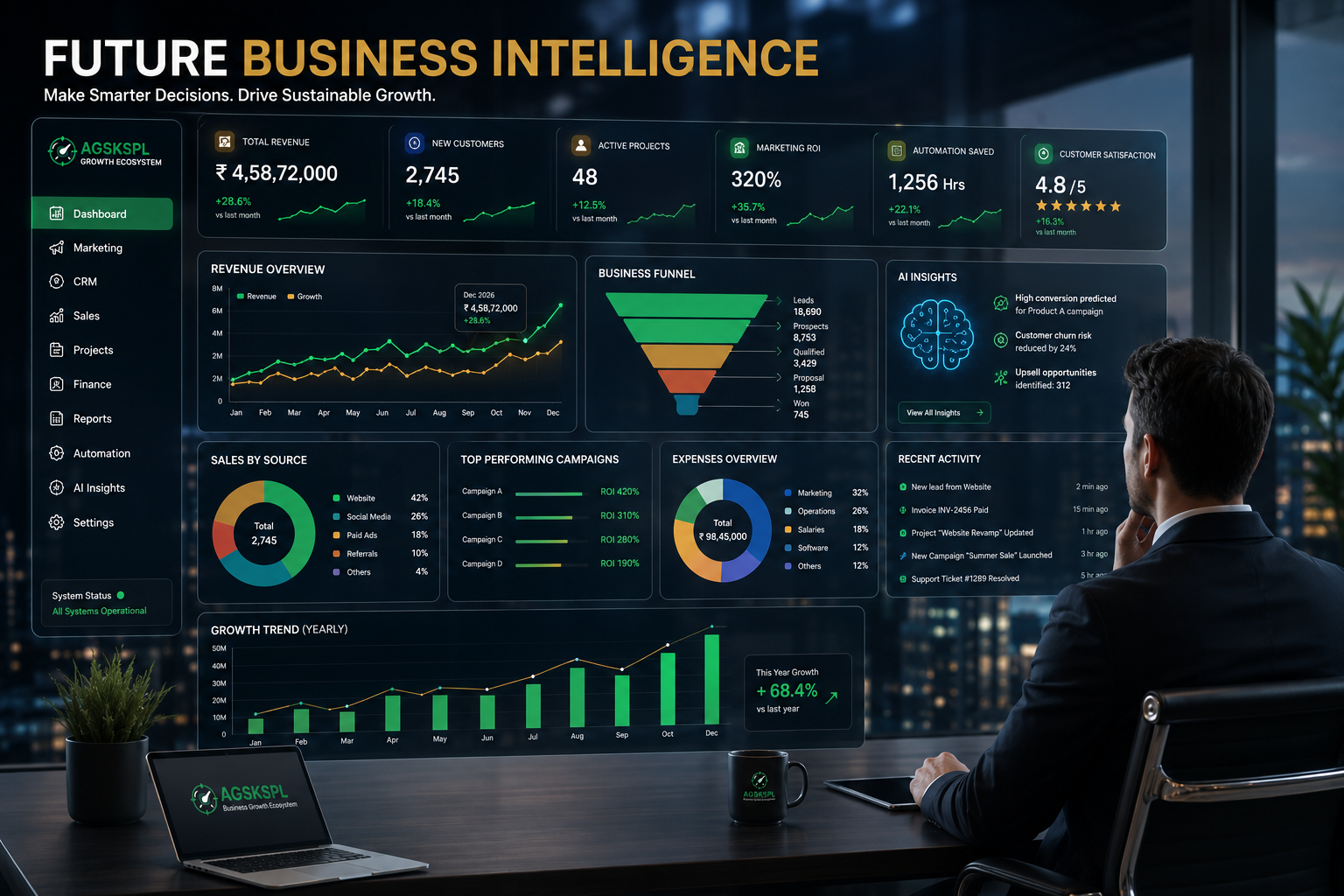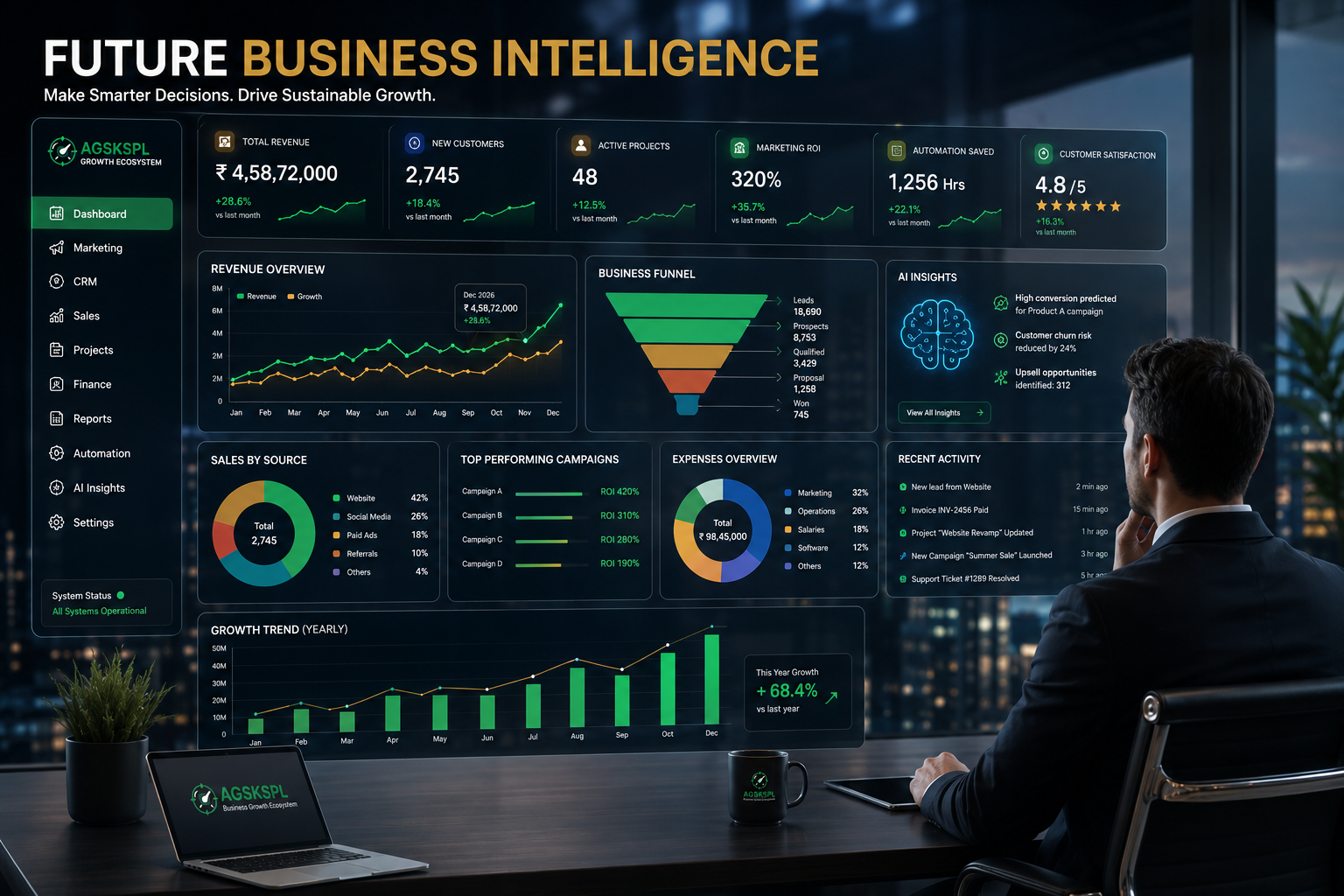
Artificial Intelligence is no longer a futuristic concept reserved for global corporations. It has become an essential business tool that helps organizations automate repetitive work, improve customer experiences, analyze large amounts of data, and make better decisions in less time.
In 2026, businesses are no longer asking whether they should use AI. Instead, they are asking how AI can be integrated into every department without creating additional complexity.
When AI becomes part of a Business Growth Ecosystem, it works alongside marketing, sales, finance, customer support, and operations instead of functioning as a separate application.
For example, imagine a customer filling out an enquiry form on your website. Instead of manually forwarding that lead to your sales team, an integrated ecosystem can instantly perform several actions automatically:
- Capture the customer information. - Assign the lead to the right sales representative. - Send a personalized welcome email. - Schedule follow-up reminders. - Analyze the customer's interests. - Generate a quotation. - Update the CRM. - Record the interaction for future reporting.
What once required several employees and multiple software platforms can now happen in seconds.
This level of automation allows businesses to spend more time building relationships with customers instead of performing repetitive administrative tasks.
Why Integration Always Beats Individual Software
Many businesses still purchase software based on individual features. They choose one platform for email marketing, another for customer relationship management, another for accounting, and yet another for analytics.
While each tool may perform its own task exceptionally well, problems begin when these systems need to communicate with one another.
Disconnected software often leads to:
- Duplicate customer records. - Different versions of business data. - Delayed reporting. - Higher subscription costs. - Complex employee training. - Manual imports and exports. - Reduced productivity.
An integrated Business Growth Ecosystem eliminates these problems by allowing every department to work from the same source of information.
Instead of switching between multiple dashboards throughout the day, employees can access everything from one centralized platform.
This not only saves time but also reduces errors and improves collaboration across the organization.
Businesses that embrace integration are often able to respond faster to customer needs, identify growth opportunities sooner, and scale more efficiently.
Real-World Examples of Growth Ecosystems
Businesses across industries are already adopting integrated ecosystems to simplify operations and improve performance.
E-commerce Businesses
Online retailers often use dozens of tools for inventory management, advertising, customer support, payment processing, shipping, and analytics.
By connecting these functions into a single ecosystem, businesses can:
- Track inventory in real time. - Launch marketing campaigns faster. - Improve customer retention. - Reduce abandoned shopping carts. - Deliver personalized recommendations.
The result is a smoother customer experience and increased revenue.
Service-Based Companies
Consultants, agencies, law firms, and marketing companies frequently manage projects across different applications.
An integrated ecosystem enables them to:
- Manage clients. - Track projects. - Generate invoices. - Schedule meetings. - Share documents. - Monitor team productivity.
Everything becomes accessible through one platform, reducing administrative work and allowing professionals to focus on delivering better services.
Manufacturing Businesses
Manufacturers rely on accurate coordination between production, procurement, inventory, finance, and logistics.
When these systems are connected, companies gain:
- Better inventory control. - Faster production planning. - Improved supplier communication. - Reduced operational delays. - Accurate financial forecasting.
Integrated data helps manufacturers identify bottlenecks before they become expensive problems.
Benefits for Small and Medium Businesses
Small businesses often assume that integrated platforms are only suitable for large enterprises. However, they often benefit the most from having everything in one place.
Instead of managing multiple subscriptions and learning several software applications, small businesses can simplify their operations through one ecosystem.
Some key advantages include:
- Lower software costs. - Easier employee onboarding. - Faster business decisions. - Better customer management. - Increased productivity. - Reduced manual work. - Improved business visibility. - Scalability without replacing existing systems.
For startups and growing businesses, simplicity can become a significant competitive advantage.
Benefits for Large Enterprises
Large organizations deal with thousands of customers, multiple departments, regional offices, and complex workflows.
An integrated Business Growth Ecosystem helps enterprises by providing:
- Centralized reporting. - Department-wide collaboration. - Enterprise-grade security. - Automated workflows. - Real-time business intelligence. - Role-based access control. - Compliance monitoring. - Better decision-making through unified data.
Instead of relying on fragmented reports from different departments, executives gain a complete view of business performance through a single dashboard.